

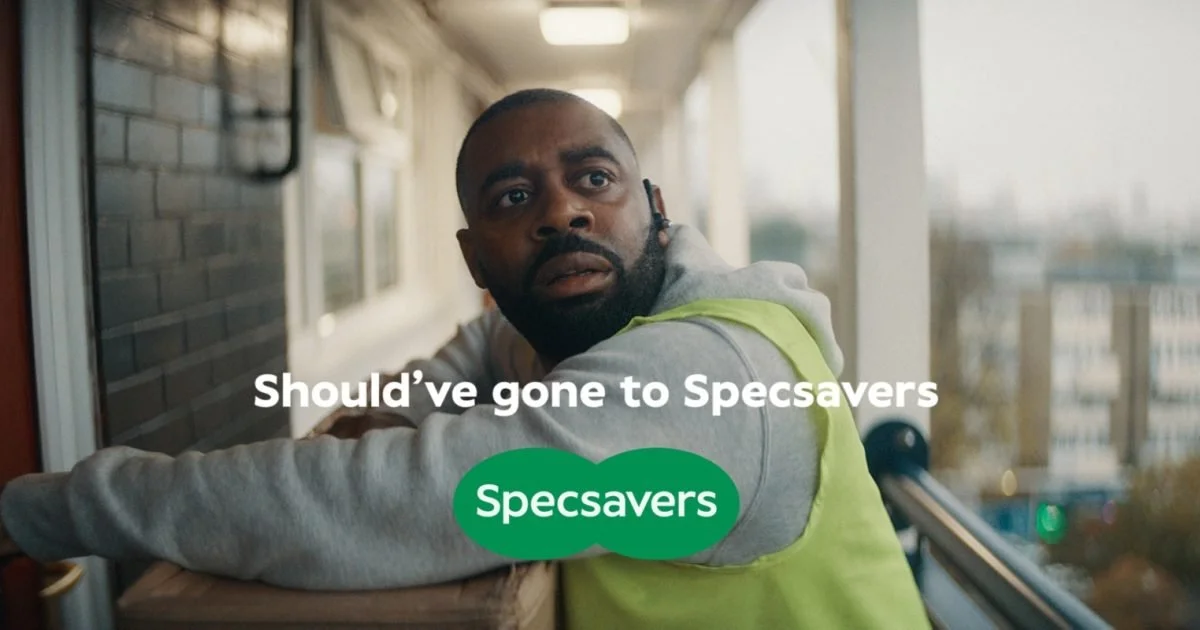
A recent interview with Specsavers’ CEO John Perkins reminded us about what an amazing example of fresh consistency the Specsavers brand is. And this fresh consistency has paid off big time. Specsavers was crowned Brand of the Year at the 2025 Marketing Week Awards. This followed its Gold at the 2024 IPA Effectiveness Awards for the “I don’t go” campaign, which subverted its famous “Should’ve gone to Specsavers” line to promote Home Visits. Specsavers has not built success by constantly reinventing itself. Rather, it has been crystal clear on what to keep, what to stretch, and where to add new energy. Here’s some key learning to use on your brand.
Post written with David Nichols, Group Managing Partner and Head of Invention.
[For non-UK readers, Specsavers is an opticians business with 2,800 stores worldwide – 900 of them are in the UK and the rest spread across Ireland, Australia, New Zealand, Canada, and several Nordic countries]
1. Consistency over time pays off
The biggest lesson from the Specsavers brand is how distinctive brand assets “compound” over time. We posted here on research showing how the most consistent brands create an ROI 4x that of the least consistent.
Early Specsavers advertising was focused on price. Since 2002, the brand has built a broader creative world around sight-related human error nd comic misunderstandings, with the brand idea “Should’ve gone to Specsavers”. After more than two decades, it remains one of the most famous campaign ideas in Britain.
It is remembered not just as an ad slogan; it has entered everyday culture. Someone misses something obvious, misreads a situation, makes a visual mistake, or simply fails to notice what is right in front of them — the line writes itself. That is the power of a true brand asset. It stops being something the brand says and becomes something people say for the brand.
Many companies would have ditched this distinctive asset by now. A new CMO might have wanted a fresh platform. A new agency might have wanted to make its mark. A leadership team chasing novelty might have decided the line was “tired”. Specsavers did the opposite. It protected the idea long enough for it to become part of popular culture.
That takes discipline. It also takes senior leadership that understands brand value. The CEO and board are, in reality, the ultimate brand managers. In Specsavers’ case, they appear to have resisted the classic “clean sheet” temptation that wipes away years of accumulated memory, recognition and meaning.
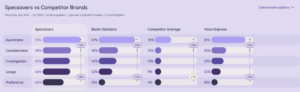
The result is visible in the numbers, sourced via an excellent report by Tracksuit . Specsavers’ awareness of 91%, far above the category average of 38% (below). What is even more impressive is how effectively awareness is turned into consideration (x75% vs. 38% average) and preferred brand (74% vs. 24% average).
2. Amplify across the whole mix
Specsavers’ campaign works because it is way more than a slogan slapped at the end of a TV ad, trapped in one channel. “Should’ve gone to Specsavers” is a true brand idea that is amplified across TV, radio, social, digital, in-store, outdoor and more. Each touchpoint reinforces the brand’s memory structure. It’s a masterclass in amplification.
Many brands get consistency wrong. They think consistency means repeating the same asset in the same format. The Specsavers brand shows that consistency can be much more creative than that.
Outdoor posters appeared upside down or badly installed, for example. On social, the brand re-posted real people’s posts “Should’ve gone to Specsavers” moments.

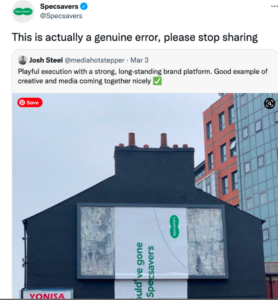
The brand even made fun of its own campaign when people posted on it!
3. Add freshness to build on your foundations
Consistency only works when it stays alive. Specsavers has managed to keep its platform fresh by evolving the situations, channels and services used to amplify it. The brand team clearly understand that the long-running platform should not be treated like a museum piece. It should be treated like a living “creative engine”. This reflects in part investment in capability building via the Specsavers Academy of Marketing to support its marketers worldwide.
“Its marketing communications are consistently excellent, establishing a strong platform that sees the brand lean into culture and confidently subvert and play with some of its distinctive assets,” observed Russell Parsons, editor-in-chief at Marketing Week (1).
For example, one execution used wrongly pasted posters.
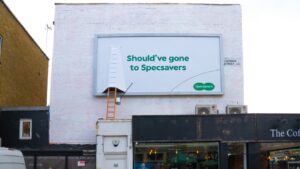
Stunts have Specsavers vans mis-parked. Outdoor posters appeared upside down or badly installed.

In another innovative execution, ITV and Channel 4 mixed up announcements, creating live“Should’ve” moments. The brand also moved into in-game advertising to reach younger audiences and lighter TV viewers. In an advertising first, Specsavers cleverly collaborated with UK broadcasters ITV and Channel 4 to create special adbreak ‘should’ve’ moments. “The Channel 4 announcer mistakenly picks up the ITV script and reads out the wrong shows – and her counterpart on ITV does the same with the Channel 4 script,” as Little Black book explains (2).
4. Root social action in product
Social action programs, as part of delivering a brand purpose, can often feel lofty, abstract and divorced from the product. They sit above the business as a statement of good intent, but do not connect back to a tangible service. Specsavers shows how social action becomes more powerful when it is rooted in the brand’s product offer. Their Home Visits proposition has social value built on the product experience itself.
Home Visits helps people who may struggle to access eye care in-store. This includes, for example, customers who are older, vulnerable or housebound and so less able to make a trip to the high street. The 2024 “I don’t go” campaign for the service won Gold at the 2024 IPA Effectiveness Awards. It uses public familiarity with the famous slogan to create a surprising twist: some customers do not go to Specsavers because Specsavers comes to them through its Home Visits service.
The social action is not separate from the commercial proposition; it is the proposition. It helps society but also helps SMS (sell more stuff). The campaign drove a 32% increase in Home Visits volumes, delivered £19.8m in incremental profit and prompted around 582,000 previous rejecters to book an eye test with Specsavers stores.
For marketers, the lesson is clear: purpose lands harder when it is made tangible. Rather than reaching for broad claims about doing good, brands should look first at where their products, services or business model already solve a real human problem. Specsavers’ Home Visits campaign worked because it made social action specific, useful and ownable.

(1) Marketing Week Brand of the Year
