


Influencer marketing is a hot topic. We posted recently on Unilever’s public commitment to use it as part of a “social-first” strategy. If you are planning to follow a similar strategy and harness creator-led content for your brand, how can you increase the chances of success? Andrew Tindall of System 1 recently shared a series of key success factors developed by social-first agency Billion Dollar Boy (1). “It’s the clearest and most practical collection of evidence, pitfalls and best practice for brand building with creator content,” according to Andrew. “Straight from a global leader in this space, doing it with huge brands.” In this post, I summarise the key recommendations, that draw on research from a range of sources including the System 1 and TikTok study I posted on here.
1. BRAND EARLY
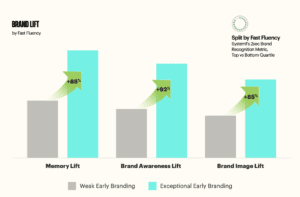
In short-form, skippable social media like influencer marketing, getting your brand noticed early is critical. Content that delivers brand recognition within the first 2 seconds saw significant lifts in brand awareness, memory and brand image, with no drop in engagement. In fact, early branding generates higher levels of positive sentiment, by allowing viewers to quickly grasp what they are watching.
2. AMPLIFY DISTINCTIVE SOCIAL BRAND ASSETS
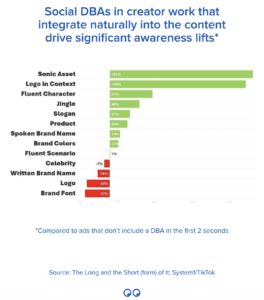
The trick to driving early branding is to use distinctive brand assets, by weaving them into the story. Brand assets that are effective at grabbing attention and recognition include logos in context (integrated into the scene) and also sonic assets like music and jingles. A logo slapped in the corner is far less effective. And don’t stop at one asset. The sweet spot is four distinctive cues in the first two seconds.
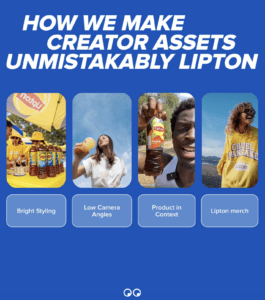
Lipton is an example of a brand using a series of distinctive social brand assets, as shared by Billionaire Boy (below).
3. BUILD A SOCIAL BRAND WORLD
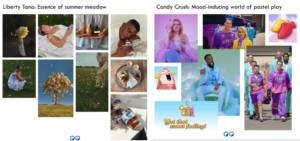
To really drive distinctiveness, brands should go beyond distinctive brand assets like music and logos to build a “social brand world”. This to me is a key opportunity, given that so much influencer marketing looks similar and one dimensional.
“Tone and mood should always reflect the brand personality,” as Billion Dollar Boy point out. “Mood becomes part of the emotional connection to the brand.” For the Liberty Tana fragrances, the agency briefed creators to explore what summer meant to them, through their own person “lens” including references to florals and tana lawn cotton. In contrast, for Candy Crush the brief was a “Mood-inducing world of pastel play.”
4. PUT ON A SHOW
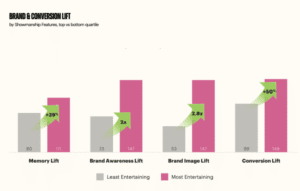
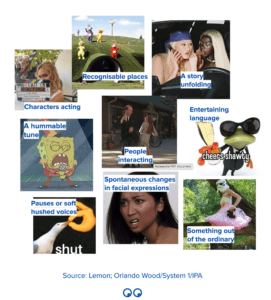
Effective short-form creator-led content doesn’t feel like an ad. It entertains, surprises and reward the viewer. “Showmanship” is the term used by System 1 to capture this idea. “Showmanship features like Story, Character, a Sense of Place and People Interacting attract the broad attention of all future buyers and leave them feeling great,” report System 1 (2). “We clearly see this impact on the formation of more branded memories crucial for long-term effectiveness.”
The most entertaining TikTok content delivered +39% memory lift, 2x higher brand awareness and nearly 3x the brand image improvement. Entertaining content also resist creative fatigue. The study found they hold attention and sentiment even after multiple exposures, while duller content decay fast.
Billion Dollar Boy helpfully unpacked and visualised the nine key ways of driving Showmanship (below).
5. EXPLORE HUMOUR LINKED to YOUR BRAND
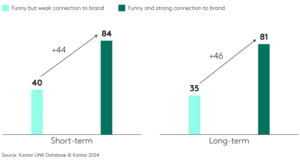
Humour can be a powerful approach in creator-led content, especially on TikTok. However, research by Kantar (3) confirms what we at the brandgym have always believed: ” In order to be effective, humour must be connected to the brand.” Without a connection to your brand, the risk is creating what we call “sponsored entertainment”! A strong connection to the brand creates a massive impact multiplier effect, from average to strong both for short and long term effectiveness (see below).
In conclusion, creator-led content might be a new channel. But the success factors are really not that different from good old fashioned TV ads: tell an entertaining story linked to your brand that amplifies the brand’s distinctive brand assets.
SOURCES
1. Linked in article by System 1
