

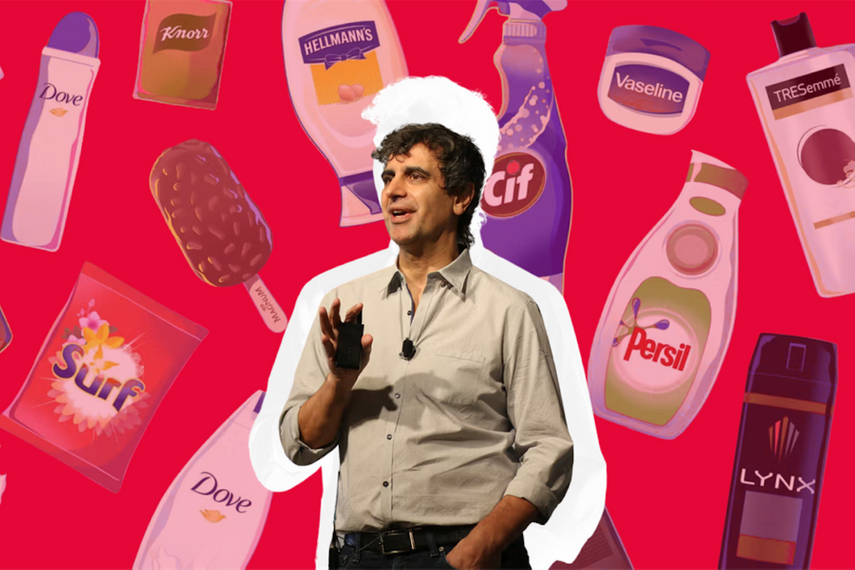
Mark Ritson recently slammed Unilever CEO Fernando Fernandez’s presentation of the company’s “social-first” marketing strategy (1), which will see social media marketing’s share of spend increase from 30% to 50%. “He has found a new doctrine—social-first, creator-led comms—and is applying it with the same portfolio-wide, broad-brush vehemence that produced the purpose debacle,” he wrote. “Different dogma. Same failure in basic brand management.”
So, have Unilever really got their marketing strategy so wrong? To explore Mark’s problems with the strategy, I watched the Fernandez’s full 25″ presentation (2). Once I got past the widely shared “30% to 50%” soundbite, Unilever’s growth strategy actually makes a lot of sense. Here’s where I agree and disagree with Mark’s points and next week I’ll share some key points missing from his column.
1. Agree: Big brand messages are not “gone”
Fernandez’s statement that “The times of big corporate brand messages are gone” is at the heart of Mark’s column. “Here is the chief executive personally pronouncing an entire category of marketing communication finished,” Mark said. “Is big brand advertising dead? Of course it isn’t.” He rightly points out that even with a social-first strategy, Unilever will spend c. $4 billion on traditional, broad-reach advertising channels. He refers to Unilever’s 2026 FIFA World Cup sponsorship as an example of a platform for big, broadcast brand messages.
Fernandez’s soundbite has created a lot of headlines, including the one in Mark’s column. However, it doesn’t really reflect Unilever’s strategy. “The times of only big corporate brand messages are gone” would have been a more accurate statement, but less provocative of course!
Unilever, in fact, sees the modern marketing landscape as an “ecosystem”, where hyper‑local micro‑influencers and mass‑participation moments work together. “Creators, fans, commentators and communities pick up what happens on the global stage, reinterpret it and carry it into their own spaces,” explains CMO Leandro Barreto (3), using the FIFA World Cup as an example. “A single moment becomes a movement because the whole ecosystem amplifies it.”
The approach is summed up with a statement that shows how Unilever is still focused on driving reach: Desire AT SCALE.

2. Disagree: “Reach requires mass media”
I’m 100% on board with Mark’s reminder that “Growth comes primarily from reaching buyers who don’t currently buy you not from deepening engagement with fans”. However, he’s not right to say “Creators are brilliant at the latter (engagement). They are considerably less good at the former (penetration).” I must admit to sharing this belief for a long time. However, done well, creator-led marketing can drive penetration.
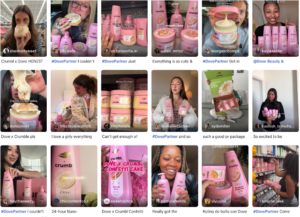
An example is Dove’s collab with dessert company Crumbl, to launch a limited-edition line of cookie-inspired products in the US (4). The campaign was backed by more than 490 creator videos on TikTok (below). The range was exclusive to Walmart and sold out quickly, hitting a six-month sales goal in one month. It has some great social stats, with 53 million video views and 3.2 billion impressions. But the killer fact? Over half (52%) Crumbl collaboration buyers were new to Dove.
We also posted recently on Not Your Mother’s, a haircare brand that has used a social-first approach to drive penetration and recruit new users. The brand has doubled in size over the last 3 years and grown by a spectacular +45% in the last 12 months, with sales over $300m
3. Disagree: “One-size-fits-all problem”
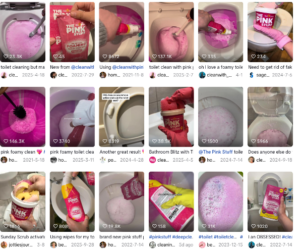
4. Disagree: toilet TikTok videos don’t work!
Sources
