


Media planning is full of myths that are great for clickbait but bad for brand building. These sweeping statements can lead teams to make poor media choices, missing out on reaching valuable consumers, especially older people who remain a big part of many markets.
The smarter approach is to follow the money. Look at who really buys your category and where those people actually spend time. Then choose the right channels based on this.
Here we bust three of these media myths.
MYTH 1: “TV is dead”
TV has been declared dead more times than we can count. The view is distorted by marketers and agency folk using their own experience, not data on real world habits.
Yes, broadcast TV reach has fallen. But “declining” is not the same as “dead”.
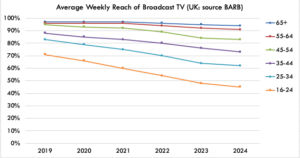
Take the UK as an example. Weekly broadcast TV reach fell overall by -14pts between 2019 and 2024, from 88% to 74%, according to Ofcom’s Media Nations report (1). But that still means you can reach 3/4 of the population with this channel. What’s really interesting in digging into the data by age (see below).
As you’d expect, the sharpest drops is with younger viewers. Viewing of 16-24s has fallen from 71% to 45% (-26 pts). However, look at older cohorts and you have a very different story. With the 55-64 age group weekly TV viewing has dropped only -5pts to 91% and with 65+ by a mere 3pts to 94%.
And it’s worth remembering that older age groups pack a lot of spending power. For example, people 50+ account for around half the household expenditure in the UK (2). This compares to a mere 9% for under 30s.
So, TV can still play a role when you need:
- broad reach including older buyers
- fame-building
- emotional storytelling
MYTH 2: “People don’t trust big brand ads anymore”
Another fashionable myth is that brand advertising is no longer trusted, especially by younger people.
A high profile example of this storyline came from Unilever CEO Fernando Fernandez. “I’m absolutely convinced that the times of big corporate, big brand messages are gone,” he stated at the CAGNY conference (3). “You need an army of people talking for your brands today.” The talk was then picked up and amplified online. “Traditional advertising still gives reach, but it no longer guarantees trust,” was a typical example from Startup Coded.
So, does the data back these claims up?
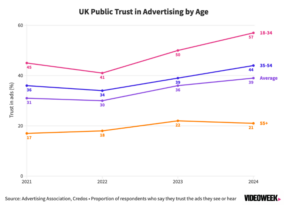
Taking the UK as an example, trust in advertising has actually gone up, not down, from 30% in 2022 to 39% in 2024. Even more interesting is that trust is more than double with 18-34s (57%) than 55+ (21%).
And what about the claim that “You need an army of people talking for your brands today”, especially with younger people? Do younger consumers really reject big brand TV ads and only trust creators, peers or “authentic” social content.
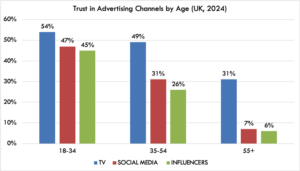
In fact, TV ads are more trusted than social media or influencers across all age groups, including 18-34s. Looking again at 55+ who account for half of all spending power, the trust gap is much bigger. Trust of TV is five times bigger than influencers.
MYTH 3: “Social media is only for young people”
The third and final myth to bust is that social media marketing is only for the younger generation. Yes, as we have seen, older folk still watch TV. But they also consume social media too!
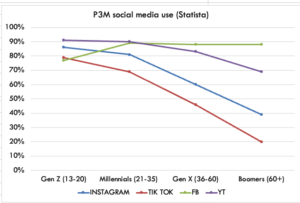
However, there is a huge difference when you look in detail at different social channels. Instagram and TikTok have grabbed lots of marketing headlines, especially as channels for influencer marketing. However, for now at least, usage drops sharply over 35 and is very low for 60+ consumers. In contrast, YouTube and especially Facebook have high levels of usage across all ages.
In conclusion, don’t believe every claim you read about media as many may be myths, like the ones we’ve shared here! Insead, dig deep into your target audience to really understand their media habits. And then create a marketing plan that integrates newer social channels and more traditional broad reach media.
SOURCES
