

More and more brand teams are using “creators”, aka influencers, as part of their marketing mix. In Kantar’s Media Reactions study, 66% of B2C marketing decision-makers said they planned to invest more in creator/influencer marketing (1). Done well, social media ads using creators can out-perform classic brand ads. However, only 29% of creator ads beat the average brand ad, according to new research by System 1, Tik Tok and WPP Media (2). The creator advantage is concentrated in a small number of strong executions, with the top 20% of ads generating 45% of what the study calls “Brand Memory Lift”. This key metric combines ad recall and brand awareness, to confirm if the memory is linked back to the brand.
The new study, The Creator Effectiveness Playbook (2), is a veritable gold mine of useful data to explain what drives strong performing creator ads. There’s so much good stuff in it that we’ll cover it in two posts. This week, we look at the insights on what actually drives effectiveness. Next week, we’ll look at practical recommendations for choosing and briefing creators.
About the study
The Creator Effectiveness Playbook by WPP Media, System1 and TikTok is based on 1,217 paid TikTok ads across eight markets: the US, UK, Germany, France, Italy, Spain, Brazil and Mexico. The study measures creative response among 182,550 TikTok users and links this to in-market brand lift data from TikTok. Across the full dataset, the work represents an estimated $70.5m in media spend and 23.6bn impressions, matched to 350+ TikTok brand and conversion lift studies.
1. Creators can create brand growth
The creator industry has often been stuck in the “social tactic” box: a way to drive buzz, views and engagement. The evidence suggests this is too limiting.
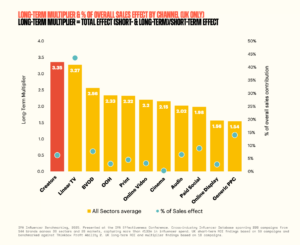
The IPA’s Influencer Benchmarking databank quote in the playbook shows that in the short term creators deliver an ROI comparable with linear TV and ahead of standard paid social. A watchout here though. In terms of scale, TV is still miles ahead. It accounted for 32% of short-term sales growth in the study, seven times more than the 4.5% accounted for by creators (blue dots below).
Creators also deliver strongly on long-term ROI. They come out equal top with linear TV on a measure called the “longer term multiplier”. This is the ratio of total growth, long term and short term, compared to short term alone (see bars below).
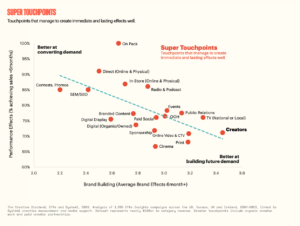
Effie and System1’s Creative Dividend research shared in the playbook points in the same direction. Creators are one of what the research called a “Super Touchpoint”, that manages to create immediate effects (vertical axis below) and lasting effects well (horizontal axis below). To note, TV is again also a strong performer.
2. Engagement does not equal effectiveness
A shocking fact from a 2025 WARC study quoted in the new playbook is that 44% of marketers run creator campaigns without setting any KPIs at all. No wonder it’s not yet treated as a fully “grown up” form or marketing!
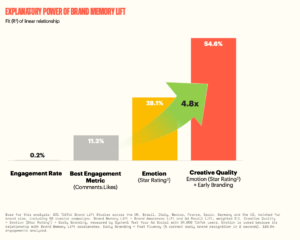
When KPIs are defined, engagement rate is still the metric most teams use. It is easy to see, easy to compare and easy to report. However, the new playbook shows that engagement rate shows no significant relationship with Brand Memory Lift. A high engagement rate can mean people like the creator, the joke or the trend. It does not mean the audience is more likely to remember the brand.
The ratio of comments to likes is a better measure for creator ads. Comments are a more active response: people have to stop, think and type, suggesting the ad provoked a reaction. However, this measure still only explains 11.3% of Brand Memory Lift.
3. Creative quality counts: emotion x early branding
If engagement does not drive Brand Memory Lift, what does?
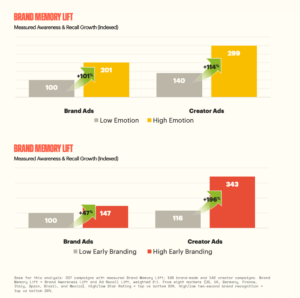
The first driver is “Creative Quality”: emotion working together with early branding. Emotion matters because it helps memory form by making people feel something. High-emotion creator ads deliver almost double the Brand Memory Lift of low-emotion ones (see below top).
But emotion alone is not enough. The brand has to show up early enough to own the feeling. This is where many creator ads fall down. The brand arrives late, appears awkwardly or is barely present at all. Creator ads with strong early branding are much more effective: they have nearly triple the Brand Memory Lift of those where the brand arrives late (see below bottom)
Delivering emotionally engaging creative AND early branding is a real double whammy for effective creator marketing. This combination is 4.8 times better at explaining effectiveness than the best engagement metric mentioned earlier, the ratio of comments to likes (see below).
4. Select creators based on fame and fit
The real magic happens when creator ads deliver on two fronts: fame and fit.
Fame means recognisability, not follower count. Does the audience recognise the creator, understand their world or quickly read the cues that make the content familiar? The Playbook gives the example of Persil working with Harry Pinero (@harrypinero), where 22% of the audience recognised him in the ad. Fame is not about chasing the biggest name; it is about choosing someone the audience knows, or can quickly place.
Fit is just as important. This is whether the brand has a credible role in the creator’s world, rather than feeling awkwardly bolted on. A strong example quoted in the Playbook is BlindTobes for Nationwide, where 59% saw the partnership as a good fit. The creator gave Nationwide a natural role: showing the value of face-to-face banking, accessibility and being properly supported in branch as a blind person.
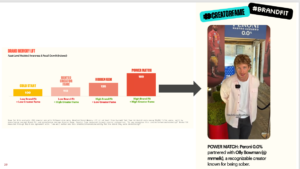
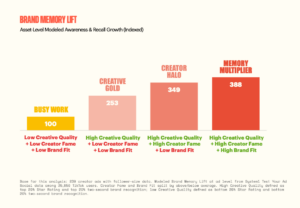
The goal is to get both fame and fit working together. A recognisable creator who is also seen as a good fit for the brand nearly doubles Brand Memory Lift versus low Creator Fame and low Brand Fit. The Playbook quotes the example of Peroni 0.0% partnering with Olly Bowman (@ mrmelk). He has fame, being a recognizable creator, but also fit as he is known for being sober.
Conclusion
In conclusion, better creator effectiveness comes from a multiplier effect from pulling several of the right levers. Getting Creative Quality, Creator Fame and Brand Fit all working together can boost Brand Memory Lift by almost 4x (see below). The winning formula is, therefore, the right creative, with the right creator, in a role that feels natural for the brand.
Check in next week when we dive into the practical playbook for effective creator/influencer marketing.
SOURCES
