

Last week, we looked at new evidence from System 1, WPP Media and TikTok showing how creators can be a serious brand-building vehicle. We also saw how the most effective creator work combines clear brand fit, creator fame and strong brand fluency, so people remember the brand, not just the content. This week, we move from insight to action. How can marketers choose the right creators, brief them properly and measure what really matters? Here, we share headlines from the very helpful and practical creator playbook introduced in the research paper (1).
Creator Playbook overview
The creator playbook has two parts.
- 1. Creator STRATEGY: choosing the right creator in the first place. This means looking for creator fame, so people recognise the person and understand their world. But fame alone is not enough. You also need brand fit: a credible role for the brand in that creator’s world.
- 2. Creator BRIEF: making the work do its job. This means creating content that is entertaining, brands early and feels native to the platform. In other words, it has to win attention, but also build brand memory.

The study shows that both parts matter. Creator ads with strong strategy and a strong brief deliver roughly double the Brand Memory Lift of work with neither (see below). And of the two, strategy is the most important: a strong strategy with a weak brief (Index 170) beats a strong brief built on a weak strategy (Index 138).!

Part 1: CREATOR STRATEGY
1A. Start with the category Need
Strategy starts not be looking at “which creator?” but rather which category need do we want the creator to bring to life? A product benefit is important. But on social, benefits need to show up as something human and easy to recognise. A skincare product is not just about “hydration”. It could, for example, be about calming down after a stressful day, feeling ready to go out or taking a moment for yourself.
This is where category need analysis helps. A useful example from the playbook looking at Beauty: Skin, Body & Hair shows how this works (1). It maps the human moments in a category in two ways: first, how much each need lifts attention and emotion (vertical axis); second, how often brands are already using that need (horizontal axis). This helps spot territories with growth potential, rather than simply following the category crowd.
- Stress Relief is a standout opportunity. It is used less than the category average, yet creates the strongest lift in attention and emotion
- Feel Confident is also under-used and performs positively, making it another attractive space for brands to explore.
- Care For Myself is already used heavily, but still works well. It remains useful, albeit more competitive.
- Look Polished, on the other hand, is heavily used but under-performs versus the category average on attention and emotion

1B. Make the creator match
Once the category need is clear, creator selection becomes much sharper. The job is no longer to find a generic “beauty creator”. It is to find a shortlist of creators who have a “creator world” where the category need feels natural. This matters, because creators work best when the brand has a believable role in the content people expect from them.
Take Stress Relief. This points towards creators whose content is built around winding down and decompression: evening routines, bath rituals, end-of-day resets etc.
In contrast, Feel Confident takes the search in a different direction. Here, the right creator world might be GRWM content (Get ready with me) for a date night or big event.
1C. Brand fit first …
As we saw last week, Brand Fit is a more important driver of creator effectiveness than fame. This means the product has a natural role in the creator’s content. The brand does not feel forced. Fame helps, of course. A recognisable creator gives the ad a head start. But if you have to choose, put brand fit first.
1D. …. then confirm creator fame
We also need to look at Creator Fame. Importantly, fame is about more than just follower count alone. Platforms now work more through the content graph — what people watch and engage with — not just the social graph, meaning who follows whom. So, the key question is: will your audience recognise this creator and quickly understand what they are known for? Smaller creators can still create fame effects if their world is clear: the format, need state, behaviour or community people already understand.
Part 2: CREATOR BRIEF
2A. USE ENTERTAINMENT TO CREATE EMOTION
The study shows a simple truth: the more feeling a creator ad creates, the more Brand Memory it builds. The most entreating creator ads deliver double the Brand Memory Lift of the least entertaining. And this applies against all sizes of creator, from Micro to Celebrity (see below). Brand made ads follow the same direction, but the effect is steeper for creators.

The practical question is how to create create the entertainment that drives emotion and memory life in creator-led marketing? This is where what System 1 call “Showmanship” comes in, as we posted on here.
Showmanship features include “something out of the ordinary”, “characters acting”, “a story unfolding”, “people interacting” and “spontaneous facial expressions”. The map below shows how these features drive both attention (vertical axis) and emotion (horizontal axis). Something out of the ordinary seems especially important. In a skippable feed, you need to break the pattern and stop the scroll.
In contrast, too much hard selling is less effective. Features such as lots of words on screen, facts and figures and telling you what to do actually drive down attention and can also reduce emotional impact (see features below circled yellow in the bottom half of the map).

2B. BRAND EARLY
We saw in the last post that early branding is key for impact. But many creators are nervous about early branding. They worry it will feel too much like an ad. Only 61% of creator ads include a brand cue in the first two seconds, compared to 89% for brand-made ads. However, the best creator work shows you can be creative and create brand impact. The trick is to make the brand part of the hook. And this is where distinctive brand assets (DBAs) play a key role.
Four DBAs stand out when it comes to brand memory lift (see below, vertical axis): logo in context, spoken brand name, written brand name and sonic assets. Of these, sound is the biggest missed opportunity. Sonic assets deliver the highest memory lift of any early cue, yet looking at the % of creators using them early (see below, horizontal axis), we see only 5% do this. One simple rule helps regarding early branding: say it and show it. Doing both increases brand recognition x7 versus doing neither.
What about the number of DBAs to use? The sweet spot is two to four distinctive brand assets in the first two seconds. At around four cues, Brand Memory Lift is strongest and attention still holds. Add more than that, and attention starts to suffer.

Entertainment creates emotion. Early branding gives the brand the credit. Platform fit is the final test. Does the work feel like it belongs in the feed? Does it feel like it comes from the creator, not from a brand trying too hard? The study shows that entertainment plus early branding lifts Brand Memory by around +69% versus creator ads weak on both. Add strong Platform Fit and the lift rises to around +79%.
This is where you need to tap into the expertise of the creator. They understand the pacing, framing, tone, formats and behaviours that feel native to the platform. One powerful way to do this is through a Social Device: a distinctive creator asset such as a repeatable format, place, prop, phrase or sound, persona or behaviour. This device belongs to the creator, not the brand.
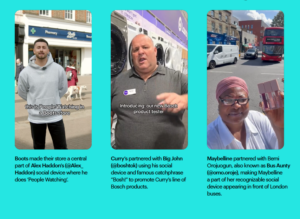
A few examples from the study (see below) show how this can works
- Boots became part of Alex Haddon’s familiar “People Watching” format
- Currys partnered with Big John, using his famous “Bosh!” catchphrase to promote Bosch products
- Maybelline worked with Bemi Orojuogun, known as Busi Aunty, using her recognisable device of appearing in front of London buses
In conclusion, the creator playbook is clear: start with the right strategy, then brief for entertainment, early branding and platform fit, so creators build brand memory, not just social media noise.
Sources
