


Have you thought about leaving the comfort of corporate life to start your own consultancy or advisory business? How can you maximise the chances of successfully making this big leap to starting a small solo business?
In this post, I summarise a set of principles that have proved effective in starting and scaling small firms over the last 24 years. I used these when I left WPP back in 2001 to launch the brandgym. The principles then helped a team of brandgym partners start their own brandgym businesses, using a shared set of beliefs, processes and tools. Friends and contacts have also found them useful when starting small firms in sectors as varied as investor relations, dance psychology, sustainability and luxury travel.
1. Forget being a freelancer!
The overall principle for a successful small firm was inspired by a life-changing book called Soloing, by Harriet Rubin. I always recommended this book when asked for advice. At the heart of the book is the need to forget about being a freelancer.
With a freelancer mindset, you charge a low fee with the hope of selling a large volume of undifferentiated work. You have to spend a lot of time chasing after the next job, competing against lots of other low priced freelancers. It’s like being trapped in a hamster wheel!
In contrast, with a soloist mindset you focus on creating and promoting a clear concept. This works like a magnet that draws people to you. Taking the brandgym as an example, we have never done traditional new business development, such as sending unsolicited emails to prospective clients. Rather, we have focused on building reputation so that people contact us directly or are referred to us.
2. Create a clear positioning
Starting and scaling a successful small firm starts with a clear brand positioning. This has multiple benefits. First, it helps you stand out from the crowd. Second, it inspires you, gives you energy and builds a sense of personal pride. Third, and perhaps most importantly, it forces you to focus, which we come back to later.
A great example of this is an investor relations consultancy started by a close friend, Mark James. Mark could have simply used his own name and gone the freelance route. Instead, we worked on creating a distinctive brand called Investor Reach, with the positioning of “Helping ambitious companies reach the right investors”. This shows the sort of companies Mark wants to work with. It also communicates the end benefit of investor relations, which is reaching and impacting the right investors. This clear positioning has helped Mark build a successful business, with clients including the London Stock Exchange.

3. Look like a pro
One of the key uses for a clear positioning is to develop a distinctive visual identity: name, logo, colour palette, visual look & feel. The basic benefit of this is to help you stand out and get noticed. But just as important is making you look polished and professional. This in turn will make prospective customers feel more confident about trusting you with their business. And it also support you charging a fair price for your work.
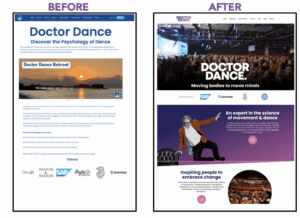
An example of this is the brand coaching work I did with Dr Peter Lovatt, aka Doctor Dance, a world expert in and keynote speaker on the transformative power of dance. The old brand presentation (below left) was very basic and didn’t do justice to the amazing and transformative experience Peter delivers. He has, for example, shared the stage with iconic figures such as Barack Obama, Richard Branson and Oprah Winfrey (“Obama was good”, said one conference attendee. “But Doctor Dance was great!”).
The new positioning we created was Moving Bodies to Move Minds: getting people moving in ways they never expected to change the way they think, feel and act. This strategic springboard was used to create a new visual identity. An updated purple vignette colour and new typeface captured the blend of scientifc expertise (“Doctor”) and joyful energy (“Dance”). A new website was designed to better bring to life the Doctor Dance brand personality of “an energising, entertaining expert”, with both more authority and more energy (below right).
4. Focus your offer
The temptation for any start-up, especially a consultancy, is to offer a long “shopping list” of services. The hope is that by “throwing lots of balls” at a potential client they will be able to catch one of them. However, in reality it’s hard to build fame and authority when offering multiple services.
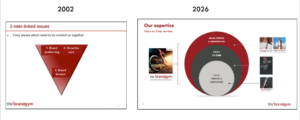
At the brandgym we’ve remained ruthlessly focused on three key services (see below): brand purpose & positioning, growing the core and strategic brand stretch. The action plans to deliver these in the market has, of course, evolved dramatically, to embrace social media and AI, for example. But the focus on the core offer has stayed the same.
5. Build a reputation “magnet”
This is the hardest part but perhaps the most important part of successfully starting and scaling a small firm. It involves using your brand positioning, beliefs and principles to develop a series of “themes” to then create a stream of added value content. For the brandgym, our themes include how to “follow the money”, growing the core and combining product “sausage” and emotional “sizzle”. Over time, this builds “distinctive memory structure” in the minds of prospective customers. It also reinforces your positioning with people you have already worked with. It works like a “reputation magnet” to draw people to you, rather than you chasing after them.
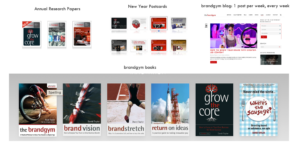
In the case of the brandgym, we have used a series of content platforms consistently for 24 years. At the centre is our series of eight brandgym books. The main book, the brandgym, covers our overall brand-led growth philosophy, approach and process. Other books focus on specific topics including brand vision, brand stretch, growing the core and innovation. These are the same areas covered earlier in Focus Your Offer. Writing each book was a monumental amount of work, requiring a lot of stamina. But the hard work has paid off handsomely, being the “content engine” of our business.
Another key content platform is the blog you are reading now. We post once a week, 52 weeks a year, with 1,793 posts in total up to now! It’s one thing to start a blog and do it for a few weeks. The real challenge is to keep this going over the long run. An example of how this can be effective is the call I got from the new CMO of Philips consumer business. She contacted me in the first week of her new role to brief us on a big project, having followed the brandgym blog for many years.
We also run an annual research project, with this years looking at Social Media Marketing. And every year we use insights from this research to create a series of New Year Cards.
A question I often get asked is about projecting and even trademarking our processes and tools. I’ve never done this, choosing instead to be generous and share everything for free. In my experience, this pays off by positioning you as an expert and encouraging people to contact you for advice on how to apply the principles.
6. Relentlessly renovate the core
It’s one thing to start a small firm and have a few good years. It’s another thing altogether to keep growing and developing for years or even decades. One key way to do this is to relentlessly renovate your core offer. This is not about launching loads of new services, which risks a loss of focus. Rather, it’s about refreshing your proposition to stay relevant.
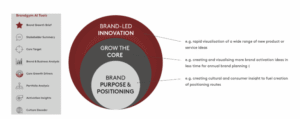
In our case, the core principles we use are the same as when we started by in 2002. However, over the years we have refreshed how we deliver these to keep up with the massive changes in marketing. For example, last year our research looked at the impact of AI on brand strategy. As part of this, we created a series of custom GPTs to help accelerate the process of developing insights, concepts and ideas (see below). This year, we’re exploring the future of Social Media Marketing.
We have also evolved how we deliver our three core offers in different ways. We now deliver team-based projects, personal brand coaching for small teams and marketing capability programs through brandgym Academy.
7. Deliver “quality at speed”
A key advantage you need to leverage versus bigger companies you may have to pitch against is agility. You might not have a big team of people like large companies. But you can use this to your advantage. With no need to delegate work, review it and change it, you can move faster. At the brandgym, we call this “quality@speed”. We have only senior partners with 30+ years experience working directly with clients and no junior people. I saw this in action today in a briefing meeting for a major food company in Southeast Asia. When the prospective client asked when we could send a set of briefing questions, my brandgym partner instantly and confidently responded, “By the end of today”!
8. Share your personal passion
Hopefully you are in the same case as myself and my brandgym partners and you are passionate about what you are offering. As self-employed entrepreneurs, we are pursuing a vocation and working on our craft, not just doing a job for a salary. Sharing this passion is a super strength for a small firm to leverage, including when competing for business with much bigger firms.
Passion for brand growth, coupled with our focused expertise in three key areas and our speed, has enabled us to pitch and win against corporate giants including WPP and Accenture. When the clients on these pitches asked us who would work on the project, we could confidently say “us!”, which would be hard or even impossible to do for the partners of bigger consultancies. They need to manage their team’s availability and are unlikely to take a hands-on role during the project.
In conclusion, successfully starting and scaling a small busienss means thinking like a soloist, not a freelancer: create a clear positioning, focus your offer, look professional, build a reputation magnet, relentlessly renovate and deliver quality@speed with personal passion.
Small firms mentioned in the post:
Invest0r relations: Investor Reach
Keynote speaking on the positive power of dance: Doctor Dance
Is soloing for you?
Here are a few final questions to help you work out if starting and scaling a solo small business is for you:
- Are you more interested in: a) security of income, b) building something you own?
- What matters most to you: a) lots of ‘resource’ on hand (PA, company car, nice office etc.), b) autonomy and controlling your own work/life balance?
- What sort of working rhythm do you prefer: a) predictable 9-5 (or 8-8!), b) happy with ‘peaks’ of activity then time to chill?
- Have you ever dreamed about starting your own business: a) no, b) yes?
- How important is direct control of a team to you: a) vital, b) secondary?
- How long could you survive with no income: a) 1 to 2 months, b) 6 months+?
- How productive are you working at home: a) end up making tea/coffee and watching TV/internet, b) get loads more work done than in the office?
If you answer mainly “b”, then going solo could be an option worth considering.
If you answered mainly “a”, then sticking to corporate life might be a better option!
