


Our 19th annual research project explores the role of social media marketing in driving brand and business growth. The topic has hit the headlines this year and is on the minds of many CMOs . Unilever’s CEO Fernando Fernandez announced that the company will move to a “social first” strategy. Spend on social channels will rise from 30% to 50% of its budget and it plans to work with 20x more influencers. In response, Mark Ritson slammed this social-first approach, calling it a “failure in basic brand management”. So, who is right?
In this first of two posts we look at the importance of social media in the marketing mix and how this is expected to change in the coming years. We then explore, the importance of connecting with your core target and integrating social media with other channels, including traditional media.
NOTE to email subscribers: apologies if the images sometimes blur, this is a Mailchimp issue. Clicking through to see the post on our website should fix this!
1. SOCIAL MEDIA GOES MAINSTREAM
For years, social media marketing was treated as a channel for challenger brands and for targeting younger consumers. Not anymore: social media has firmly entered the marketing mainstream. 85% of marketers now see it as effective for big mass-market brands, almost as high as the 95% for smaller challenger brands. And 91% expect social media to become even more important over the next two to three years.
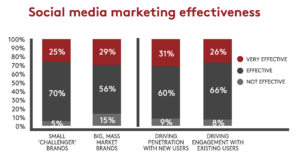
It is also seen as being equally effective (90%) at driving penetration as driving engagement with existing brand users. Dove’s collab with dessert company Crumbl on a limited-edition line of cookie-inspired products is an example of how this can work. Over 50% of buyers of the product were new to Dove. Over 490 creator video on TikTok drove 3.2 billion impressions and the range sold out quickly.
2. FOLLOW YOUR CONSUMER, NOT THE HYPE
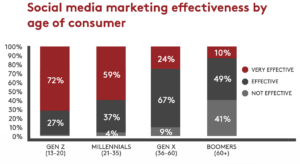
Social media marketing is, as expected, seen as very effective for targeting younger consumers, esp. Gen Z (72% very effective). However, marketers see effectiveness dropping for reaching older consumers, especially Boomers. Here, only 10% see social media as very effective and a significant 41% see social media as not effective.
Older consumers are often neglected by marketing teams in favour of focusing on younger consumer groups. However, they represent a big share of consumption, especially for everyday consumer goods. For example, 50+ consumers account for 56% of household spending in the UK, 3x the share of people under 30. This is why integrating social and traditional media remains important (see point 3 below).
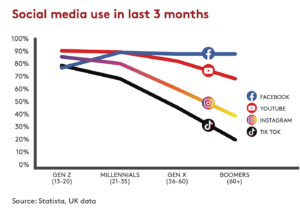
For brands where older consumers are important, which includes many of our FMCG clients, social media channel selection is key. Instagram and TikTok have grabbed lots of marketing headlines, especially as channels for influencer marketing. However, for now at least, usage drops sharply over 35 and is very low for 60+ consumers. In contrast, YouTube and especially Facebook have high levels of usage across all ages.
Starbucks shows how a brand can adapt social activity by target. It uses Facebook to connect with Gen X and Boomers through communities and loyalty rewards, while TikTok and Instagram are used to create buzz with younger consumers around trend-responsive products such as the Unicorn Frappuccino.
3. INTEGRATE SOCIAL AS PART OF THE MIX
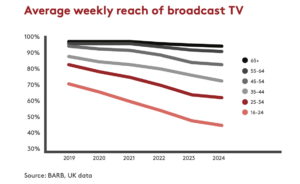
Only a minority (20%) share Unilever’s CEO view that the “the times of big corporate, big brand messages are gone”. The vast majority of marketers (75%) say social media works best together with traditional media, like TV, sponsorship & PR. Despite claims traditional media like TV are “dead”, they remain key channels. In the US, $40billion is still invested on TV advertising for example. And TV plays a key role in reaching older consumers who, as we saw earlier, are a key part of many markets. For example, broadcast TV reach in the UK for people 55+ is flat since 2019 (see below). Reach has dropped sharply with 25-34s since 2019 (-19 pts), but is still a high 62%.
Too often, social media is planned in its own silo, sometimes by a separate agency with what amounts to a separate brand strategy. The result can be fragmented marketing and inconsistent brand messaging. Our alternative is to create integrated “brand chapters”. Each chapter brings the brand story to life with a fresh piece of activity, with different channels playing complementary roles. WD-40’s Repair Challenge is a good example. The activation ran in more than 40 countries, with paid and organic social encouraging consumers to share repair projects. In-store display helped grab attention and drive sales, while a partnership with the iFixit repair community added further reach and credibility.

In conclusion, social media marketing has gone mainstream, but that doesn’t mean every brand should become “social-first”. Start with your consumer and then integrate social into the wider marketing mix to reach them. In next week’s post we look at the challenge of engaging your consumer AND selling more stuff.
