


Even if you’re not seeking to raise money from investors, pitching is super important. We are ALL selling ALL the time, whether you are an agency pitching for new business, an interviewee trying to get a new job or a team launching an internal program. The latter challenge came up this week in a coaching session with a global marketing team launching a marketing capability program. The sales deck was sound. But it was a rational presentation not an emotionally compelling sales pitch.
This prompted me to dig out a great Linked In post I saved by Andy Raskin (1) on “The greatest sales deck ever”. The sales deck in question was for Zuora, a monetisation platform for companies looking to create subscription-based offers. Zuora was recently acquired by Silver Lake and GIC for a cool $1.7billion, so it seems the sales deck was pretty effective!
So, here are the 5 key steps to help you create a killer pitch …
#1. Name a Big, Relevant Change in the World
Most sales pitches start with with “what” is being offered. “This is our company and we sell x, y or z”, for example. Andy advises against this. “Don’t kick off a sales presentation by talking about your product, your locations, your clients, or anything about yourself,” he says. Instead, he recommends highlighting a shift in the world that has big stakes and huge urgency for your prospect. “You get prospects to open up about how that shift affects them, how it scares them, and where they see opportunities. Most importantly, you grab their attention.”
Here is how Zora do this. The phrase “subscription economy” sums up in a distinctive and memorable way the trend of people making recurring payments rather than one-off purchases. A follow-up slide shows the history of the change that has happened.

#2. Show There’ll Be Winners and Losers
The second step addresses a phenomenon called “loss aversion.” People tend to stick with what they know and don’t like change. To get over this barrier, you have to “demonstrate how the change will create big winners and big losers.”
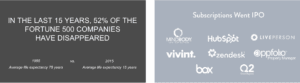
Zuora demonstrating the risk of not changing by showing how over half the Fortune 500 companies disappeared in the last 15 years. In contrast, winning companies have shifted from selling products to selling subscription services.
#3. Tease the Promised Land
The next step is to present a taster of what Andy calls “the happily-ever-after that your product/service will help the prospect achieve—the Promised Land.” This Promised Land should be desirable but hard to achieve without help from you.
Zora’s Promised Land slide shows the customer benefits of the ideal subscription experience. Notice how we are still yet to talk about what we’re selling. Instead, we are building desire to reach the ideal future state.

#4. Introduce Features as “Magic Gifts”
Only now do you start to talk about what you have to offer. Here, Andy draws on a Hollywood movie analogy. “When you introduce your product or service, do so by positioning its capabilities like the lightsaber, wizardry and spells—as “magic gifts” for helping your main character (prospect) reach that much-desired Promised Land,” he suggests
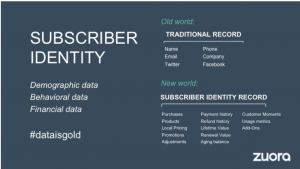
Zuora do this by talking about the structure of its customer record, called a “subscriber identity”. Out of context, this detail would likely bore even the most technical prospect. However, positioned in the context of making the leap from the old economy to the subscriber economy it becomes much more compelling.
.
#5. Present Evidence You Can Make the Story Come True
The road to the Promised Land is of course not an easy one, with many obstacles to overcome. And prospects may be skeptical of your ability to deliver. Now it’s time to show some evidence that you can actually take your prospect on the journey to the promised land. Here, “social proof” comes in: success stories about how you’ve helped someone similar to your prospect achieve success.
Zora has a set of customer success stories, such as this one from NCR.

So there you have it. 5 steps to a killer sales pitch which build on the principles of storytelling. They helped the global marketing team I mentioned earlier deliver a winning pitch for their capability program. Why not try them out on your next presentation? And do let me know how you get on!
Sources:
