

An FT article on AI grabbed my attention this week. “Is AI an exoskeleton* for the mind?” the article asked (1). This prompted me to revisit the paper we wrote on the impact of AI back in April 2025. At the time, we were worried about AI’s impact on the brand strategy work we do. A new agency was offering to do brand strategy projects at the push of a prompt, in just a couple of hours. “Is AI about to replace creativity and collaboration?” we asked ourselves.
“No”, was the answer we came up with.
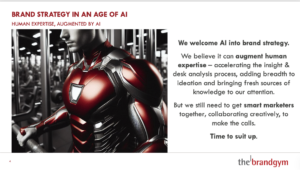
Rather, in our paper we set a vision where AI would augment rather than replace human experience and expertise in brand strategy (see below). Similar to the FT article’s exoskeleton metaphor, we visualised AI being like the suit Iron Man wears in Marvel movies. His suit added speed and power but still needed to be navigated and directed by a human.
So, fast forward to today, what has happened? And what have we learnt?
* Exoskeleton: a motorized wearable frame that can help individuals with paralysis or injury walk
1. Collaboration is more critical than ever
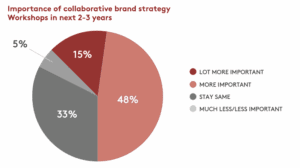
Collaborative workshops show no sign of being replaced by brand strategy done at the push of a prompt. In fact, 63% of marketers in our brandgym research see an increased importance for brand strategy workshops (see below).
In an age, where everyone is using AI, human collaboration is key to find a creative edge.
In addition, AI generates high volumes of ideas early in project, with variable quality. This creates a need to get smart people together to review, prioritise and blend these ideas.
WD-40 Company is an example of a business that believes in the continued value of collaborative brand strategy workshops. “Global brand workshops help teams build connection, deepen cultural understanding and drive alignment,” explains CMO Claudia Fenske. A structured sequence of workshops each year allows a Global Brand Team, made up of different country and global marketers, to refresh global strategies, generate & prioritise marketing plan ideas and work on global implementation. This approach has boosted consistency of global brand execution from 68% to 100%
Another CMO zoomed in on the human expertise needed to facilitate effective brand strategy workshops. “Bringing together the right people and facilitating the right discussion is needed for powerful outputs,” he commented. “I can’t see how this can be replicated by AI, in the short term at least.”
2. The role of AI varies by stage of project
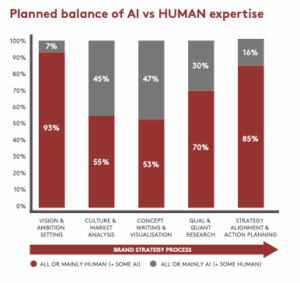
We are finding that the optimum blend of AI and human talent varies by the stage of a brand strategy process. In line with our brandgym research, AI has a key role to play in the early to mid stages of a project (grey bars in chart below). It is helping accelerate Culture & Market Analysis, Concept Writing & Visualisation. We now have a series of brandgym.ai “agents” that help speed up the process of creating ideas and insights that feed into our workshops and coaching sessions.
In contrast, Vision & Ambition Setting at the start of a project and Strategy Alignment & Action Planning at the end need mainly human input and collaboration (red bars in chart below).
3. AI can’t be fully trusted
Another reason we haven’t been made redundant by AI (at least for now!) is the enduring need for trusted advisors. When it comes to important, business critical brand strategy work, expertise and experience are still preferred by most companies over an AI “black box”.
AI is great at creating a large volume of ideas at speed. However, the results are not always reliable. Indeed, over-relying on AI can be risky, as shown by the example of elite Wall Street law firm Sullivan & Cromwell. The firm had to apologise to New York federal judge for errors made in a filing for a high-profile case caused by “hallucinations” generated by artificial intelligence, as reported in the Guardian (2)!
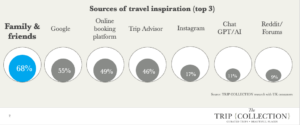
The importance of advice from people you trust is shown in research for my passion project, a travel inspiration platform called The TRIP COLLECTION. We looked at the most important sources of travel inspiration when planning a trip. Family & friends came out top of the list, six times more important than Chat GPT/AI. We did wonder if human recommendations would decline as AI grows. However, 30% said travel recommendations from people you trust would increase and 59% said they would stay the same.
In conclusion, we suggest AI’s role in brand strategy is like an electric bike*. It allows you to go further and faster but still needs human talent to direct it. And collaborative workshops that bring smart people together will continue to play a key role in doing this.
*Thanks to Adam Morgan for sharing this metaphor with me. Though it seems Steve Jobs said something similar a long time ago! He called the personal computer a “bicycle for the mind” because it amplified human effort but still required you to pedal.
Sources
1. FT article
