

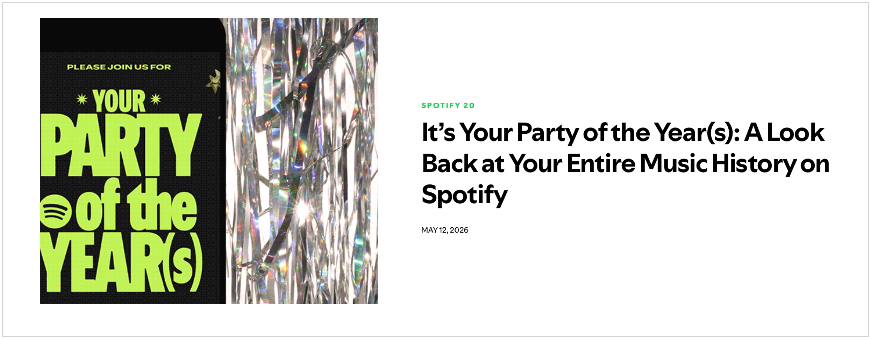
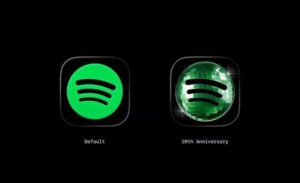
Spotify’s new app icon has sparked a lot of debate. To mark their 20th anniversary, a sparkly green disco ball has replaced the familiar green circle. Many reactions have been negative. “Their 20th anniversary icon is one of those design/marketing moments where I just scratch my head,” said social media commentator Jack Appleby (1). “There’s no strategic reasoning to changing your app icon.” On the other hand, Andrew Tindall of System 1 loved the change. “This is a world-class marketing move from Spotify, in a sea of tech and AI brands that all look suspiciously the same,” he said (2).
So, who is right? And what can we learn from this change of visual identity?

1. Hit! Added value celebration
Going beyond the change of the icon, there is actually some good substance in what Spotify is doing. Many brand anniversary celebrations are “brand ego trips”: self congratulatory back-slapping exercises with no added value for consumers.
When I actually explored my Spotify app to write this post, I discovered some very cool features the brand had added. For example, the app created a “My Wrapped Rewind” playlist, featuring 50 most-played songs from past years (being a fan of soul music, my 3 daughters will say that all 50 songs sound the same!). This is an example of using an anniversary to add value to the customer experience. I’m also likely to share my playlist, raising brand awareness for Spotify and potentially driving penetration.

2. Mistake! Looking at design changes out of context
Perhaps the most important learning here is how to look at new design options. Both Jack and Andrew make the mistake I often see brand teams do: looking at a new design out of context. The image they use (below) shows the new logo:
- Side-by-side with the old one, something users will never see in real life
- Blown up bigger than normal
- In beautiful isolation on a black background, rather than on a phone screen
This leads to a rational, “system 2” view of the new design. As a result, marketing folk launch into in-depth analysis that bears no resemblance to the spilt second, system 1 way real people look at brands
3. Miss! Poor execution adds friction
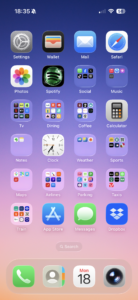
“We don’t scroll through a new, random assortment of icons every hour, wondering what to tap,” comments Andrew, to support his view that the new icon is smart not stupid. However, by looking at the design out of context, he fails to identity the main role the app icon should play, which is making everyday life easy.
Looking at the new app in real life context on my iPhone (see below), shows the shortcomings of the new app icon. Before reading articles about it, I was confused by how 💩 the new icon looked. Only when I read the posts in the icon and saw the blown up version did I realise it was a disco 🪩 ball!
And it seems I’m not alone. “Every single time I look at it, I think it’s downloading/updating. It is beyond awful,” said one user (3). “On CarPlay I was like ‘Where did Spotify go?!’ Then, like mentioned by others, I thought I missed my subscription payment,” said another.
This is not adding value. It’s adding friction. It makes everyday use of the app more of a hassle.
4. Miss! Lack of consistency
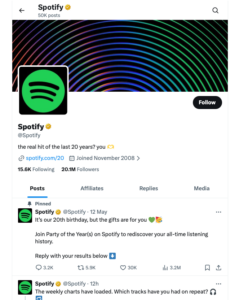
Another reason why the new icon is not “world-class marketing” is the surprisingly failure to amplify the new icon across the mix. For example, Spotify’s X account uses the normal logo with the green circle and black stripes. This is a missed opportunity to raise awareness of the 20th Anniversary celebration and added value features on offer.
5. Recommendation! Execute well
With a consumer goods brand, changing a logo and changing it back creates huge expense and complexity. It also does risk confusing consumers and missing out at the point of sale. This is why I wouldn’t recommend a temporary logo change for this sort of brand.
However, changing a logo or icon to mark an occasion is easier for online brands like Spotify. The change can be made quickly, easily and with little of no cost. It can also be changed back instantly. And it has the benefit of stopping people scrolling on their phones.
So, in principle, Spotify changing its icon to mark its anniversary could work well. The issue that has provoked criticism is that the execution is poo. As Jack points out (2), there are “huge readability & brand issues: Different color green, the green is too dark against the black, disco ball texture looks pixelated on a tiny phone screen”.
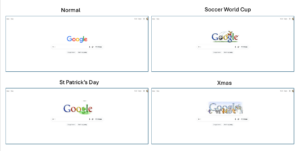
For a better example of temporary logo changes, look at Google. They often change the logo on their homepage to mark seasonal moments. These work well to add some fun to your day, make the brand more human and, importantly, don’t add any friction.
In conclusion, the Spotify icon change shows the need to look at any temporary design change in context and ensure that it signals some real consumer added value, rather than being a brands ego trip!
SOURCES
