

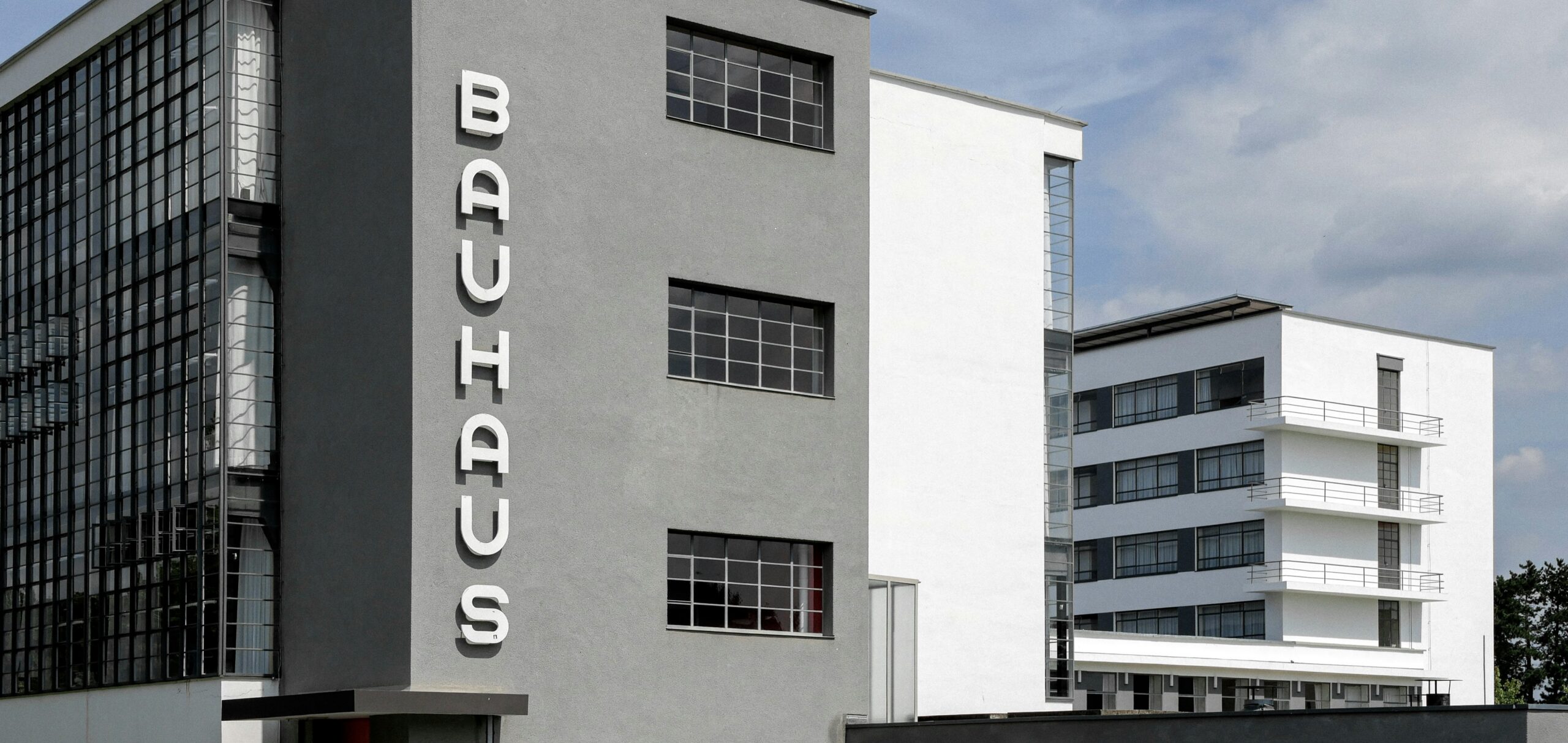
What can a 100-year-old German design school teach us about brands building today? Quite a lot, it turns out! The latest week of my Creative Life Mini Masters took me back to the Bauhaus in the 1920s. I went into the topic expecting mainly to learn about modern design: geometric shapes, tubular steel furniture and buildings with flat roofs. But what interested me most was not the distinctive Bauhaus look. It was the way Bauhaus designers worked. And this feels surprisingly relevant to brand building today.
Here are six practical Bauhaus principles that you can steal with pride.
Cover photo by Ben Benjamin on Unsplash
A quick Bauhaus background
The Bauhaus was a pioneering German school of art and design, founded by architect Walter Gropius in 1919. Its aim was to break down the barriers between art, craft and technology. Students learnt fundamentals such as colour, form and materials before moving into hands-on workshops covering everything from furniture and metalwork to textiles, typography and architecture. The ambition was practical as well as creative: use design to create better products and places for modern life.
1. Start with the problem, not the answer
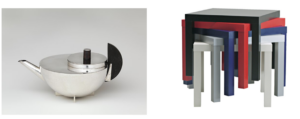
One of the most famous Bauhaus objects is Marianne Brandt’s 1924 tea infuser (below left). Rather than simply designing a more attractive version of a conventional teapot, Brandt focused on what the object actually needed to do. The result was a compact pot designed to make concentrated tea that could then be diluted with hot water. Its striking form grew out of its function rather than being decoration added afterwards.
IKEA’s LACK table (below right) is a modern-day example of the same problem-first thinking. The starting challenge was to create a small, flexible table at an incredibly low price. An early particleboard prototype looked good but was too heavy and expensive at 298 kronor (EUR 29.80). “Hell no! It can’t cost more than 75 kronor!” was the response of founder Ingvar Kamprad. This led the team to use lightweight board-on-frame construction, a technique already used by IKEA for larger tabletops. The resulting LACK launched at just 78 Swedish kronor (EUR 7.80).
Brand growth inspiration: Write a one-sentence problem statement before starting creative development. If you can’t agree on the problem, you’re not ready to work on the answer.
2. Look outside your category
Marcel Breuer’s famous Wassily chair (below left) shows the power of looking beyond your immediate world for inspiration. Traditional club chairs were big, heavy and upholstered. Breuer instead took inspiration from the lightweight tubular steel used in bicycle handlebars, exploring whether the same material and manufacturing principles could be applied to furniture. The result looked radically different from conventional chairs. The iconic design is still contemporary 100 years later.
P&G’s Swiffer WetJet (below right) shows how brands can use the same approach. Faced with the problem that conventional mopping required a cupboard full of different supplies, P&G didn’t restrict itself to looking at other floor cleaners. Its scientists combined absorbent non-woven material technology similar to that used in Always sanitary pads with liquid-cleaning expertise from Mr. Clean (1). The result helped establish a new “Quick Clean” category.
Brand growth inspiration: When tackling a brand challenge, ask: who has solved a similar problem brilliantly in a completely different market? Borrow the principle, rather than simply copying what your competitors already do.

3. Use prototypes, not just Powerpoint
Making was central to the Bauhaus approach. Students didn’t just sit in classrooms discussing theories of design. They moved into workshops where they experimented with materials, built prototypes and learnt by doing. Marianne Brandt’s famous tea infuser, for example, was handmade in the metal workshop as an experimental prototype exploring how a modern product could eventually be manufactured more widely.
Dyson took prototyping to another level. James Dyson spent four years developing 5,127 prototypes of his bagless vacuum cleaner before arriving at a version that worked. His starting point was decidedly low-tech: a cardboard cyclone attached to an existing vacuum. Each prototype generated learning that fed into the next one.
There is a lesson here for brand teams, who can spend far too long debating concepts in meeting rooms and PowerPoint decks. Ideas become much easier to evaluate once they are tangible.
Brand growth inspiration: Move from PowerPoint to prototype as fast as possible. Make ideas tangible early, test them and improve them.

4. Bring different disciplines together
One of the most radical things about the Bauhaus was the mix of creative disciplines under one roof. Johannes Itten taught fundamentals of materials, composition and colour. Paul Klee and Wassily Kandinsky explored form and colour. Marianne Brandt became a leading figure in metalwork.
The important point wasn’t simply that the Bauhaus did lots of different things. It was that different types of expertise rubbed up against each other, creating ideas that might never have emerged inside traditional academic silos.
Nike’s Breaking2 project is a brilliant modern-day example. To try to break the two-hour marathon barrier, Nike didn’t treat it simply as a footwear design challenge. It brought together designers, engineers, biomechanists, physiologists, materials developers, nutritionists and data specialists, working alongside elite athletes including Eliud Kipchoge. The team tackled everything from shoes and clothing to nutrition, training, aerodynamics and race conditions.
Brand growth inspiration: Build genuinely cross-functional teams around your biggest growth challenges. Get marketing, insight, R&D, design, digital and commercial people solving the problem together, rather than handing it from one silo to another.

5. Build a brand ecosystem
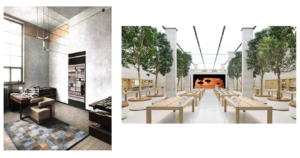
The Bauhaus ambition eventually went beyond creating individual objects. Architecture, furniture, lighting, textiles, typography and graphics could all work together as one connected system. You can see this in the Bauhaus Director’s Office (below left) and exhibition houses, where the architecture could be complemented by furniture, lamps, textiles and other objects created by the school’s different workshops.
Apple is perhaps the ultimate modern example of this idea. It doesn’t just sell a series of standalone products. iPhone, Mac, iPad, Apple Watch and AirPods work together through a connected software and services ecosystem, supported by accessories such as keyboards, cases and chargers. And the ecosystem extends into the physical world through the Apple Store, where the products, accessories, service, support and brand experience come together in one place.
This is bigger than visual consistency. It is about creating multiple ways for consumers to buy into and engage with the brand, with each element strengthening the others.
Brand growth inspiration: Map your brand ecosystem. Look beyond your core product and ask how products, services, digital experiences, accessories, channels and partnerships could work harder together to sell more stuff and strengthen the overall brand.
6. Less is more
One of the lasting influences of Bauhaus modernism was the drive to strip away unnecessary decoration and excess. The aim wasn’t minimalism simply for aesthetic effect. It was to focus attention on what an object actually needed to do and make that work brilliantly.
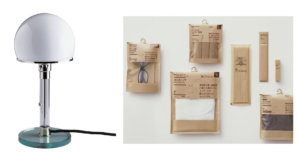
The Wagenfeld table lamp, designed at the Bauhaus in 1924, captures the idea beautifully (below left). Its simple geometric glass shade, metal stem and circular base dispense with the decorative flourishes found on many lamps of the period. The result is simple, functional and still looks remarkably contemporary a century later.
MUJI has built an entire modern brand around a similar philosophy (below right). Its products deliberately avoid unnecessary features, excessive packaging and prominent branding. PProduct designer and MUJI advisory-board member Naoto Fukasawa describes his approach as combining just enough function with minimal form. MUJI itself argues that simplicity creates universality: products that do their job without shouting for attention.
Brand growth inspiration: Try a subtraction exercise. Ask what you can remove from your proposition, portfolio, pack or communication without reducing its effectiveness. Strip away the excess until the few things that really matter have room to shine.
In conclusion
In conclusion, the Bauhaus can inspire brand teams to start with a clear problem definition, look outside their categories, then combining disciplines to prototype ideas.
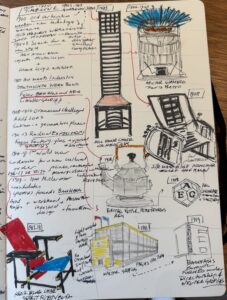
For fun, my visual summary of the week’s learning is below!
SOURCES
